Here is the failure I expect from an agency that switches on AI follow-up before auditing its CRM. Suppose a prospect fills in a form twice, six weeks apart, once with a work email and once with a Gmail address. Two contact records exist, one at Proposal Sent and one at New Lead. The AI sequence reads the second, sees a fresh untouched lead, and sends the "thanks for your interest, what are you trying to solve?" message to somebody who signed a contract on Tuesday.
Nobody wrote a bug. The automation did what it was told, against data that was wrong before the automation existed.
That is the part agencies underestimate. A broken integration throws an error and somebody gets a notification. AI acts on bad input without hesitating and produces something plausible. There is no red banner. The wrong lead gets the follow-up, the wrong number lands in the client report, and it all happens at machine speed with nobody reading each action on the way out.
CRM cleanup used to be a hygiene chore you could defer for a quarter. Once automation sits on top of the same records, it decides whether the automation is safe.
What changes when AI reads a dirty CRM?
Three things change, and none of them are about the AI's capability.
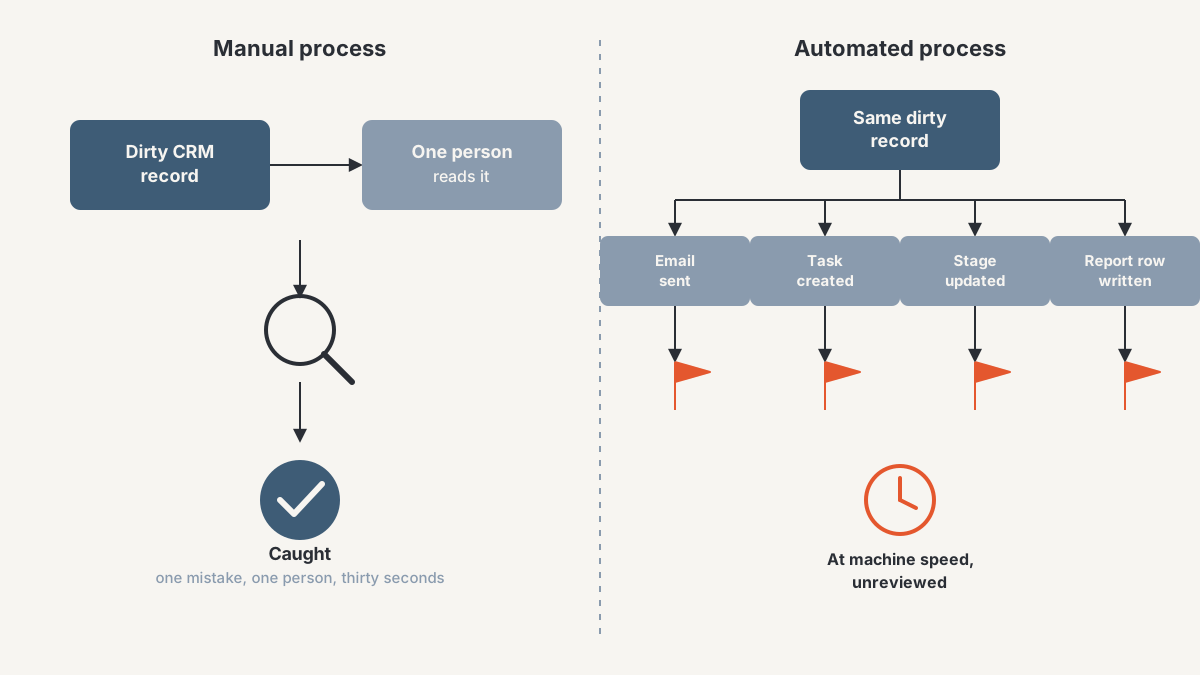
Errors stop being local. A duplicate record used to cost one salesperson thirty seconds of confusion. Wire an AI sequence to the contact list and that same duplicate produces a message, a task, a stage update, and a line in the monthly report. One bad row touches four systems.
They also stop being visible. Nobody emails a contact named "unknown" with no phone number and a deal value of $0. Ask a model to draft a follow-up for that same record and it produces a perfectly reasonable email. Fluent output tells you nothing about whether the input was usable.
And they stop being slow. If your data has a 5% problem rate and a person handles forty contacts a day, you get two mistakes and probably catch one. If the automation handles four thousand, you get two hundred and find out when a client forwards you a screenshot.
What I'd want in place instead is a practical AI workflow: AI connected to real business data, with deterministic rules around it, limits on what it can do unsupervised, and human review where being wrong is expensive. All of that assumes the data underneath is trustworthy first.
Which CRM field problems actually poison automation?
Not all messy data breaks automation equally. Five problems do most of the damage, roughly in order of how often I find them.
Duplicate contacts
Duplicates corrupt both directions at once. Automation reads the wrong record and acts on stale context. Reporting counts the same human twice, inflating lead volume and every ratio built on it.
Merging rewrites history too. The surviving record keeps one set of attribution fields and the other campaign's touch is gone, which is a reporting problem I've covered in why your GoHighLevel numbers don't match GA4. Add AI on top and that missing history becomes the context the model reasons from.
Identity fields that aren't normalized
Email and phone are the keys everything joins on, and they arrive from forms in whatever shape a human typed them. +1 (555) 010-9999, 555-010-9999, and 5550109999 are one person and three keys. Case variants, trailing spaces, and the +tag suffix Gmail allows do the same thing to email.
This is the quiet one. Dedupe rules don't fire because the keys don't match. Ad platform reconciliation fails for the same reason. Any AI step asking "have we spoken to this person before" gets a no when the answer is yes.
Missing or wrong record ownership
Ownership determines routing, and routing determines who is accountable when the automation gets it wrong. An unowned record has no human downstream, so an AI-generated task goes nowhere and an AI-drafted email goes out with nobody reading the reply.
Ownership decays silently too. A rep leaves, their contacts stay assigned to a deactivated user, and nothing in the interface complains. Six months later a chunk of the pipeline belongs to someone who left.
Stale and inconsistent stage data
Stage is the field automation trusts most and humans maintain least. Deals close over the phone and nobody drags the card. Dead opportunities sit at Proposal Sent for months because there's no stage that means "gave up".
Two failure modes follow. AI follow-up reads stale stages as live intent and pesters dead deals. AI summaries and forecasts read the stage distribution as current when it's an archaeology layer.
Some CRMs add a structural problem underneath: stage changes overwrite rather than append, so the previous state is gone and you can't audit what the record looked like when the automation acted on it. I go into that gap in GoHighLevel overwrites your pipeline history.
Definition drift in custom fields
The one that costs the most to fix later. A field called budget gets created for one client's intake form. A second person uses it for monthly retainer, a third for total project value, and somebody starts typing "TBC" and "~5k, flexible" into it because it's a text field and nothing stops them.
Now ask an AI to score leads by budget. It will do it. It will handle the free text without complaining, infer a number from "~5k, flexible", and hand back a ranked list that silently mixes monthly and annual figures. Formatted like analysis, comparing two different things.
If a field feeds a decision, it needs a controlled set of values, and the reason isn't tidiness. A picklist can be validated. A sentence someone typed cannot.
What order should you clean in?
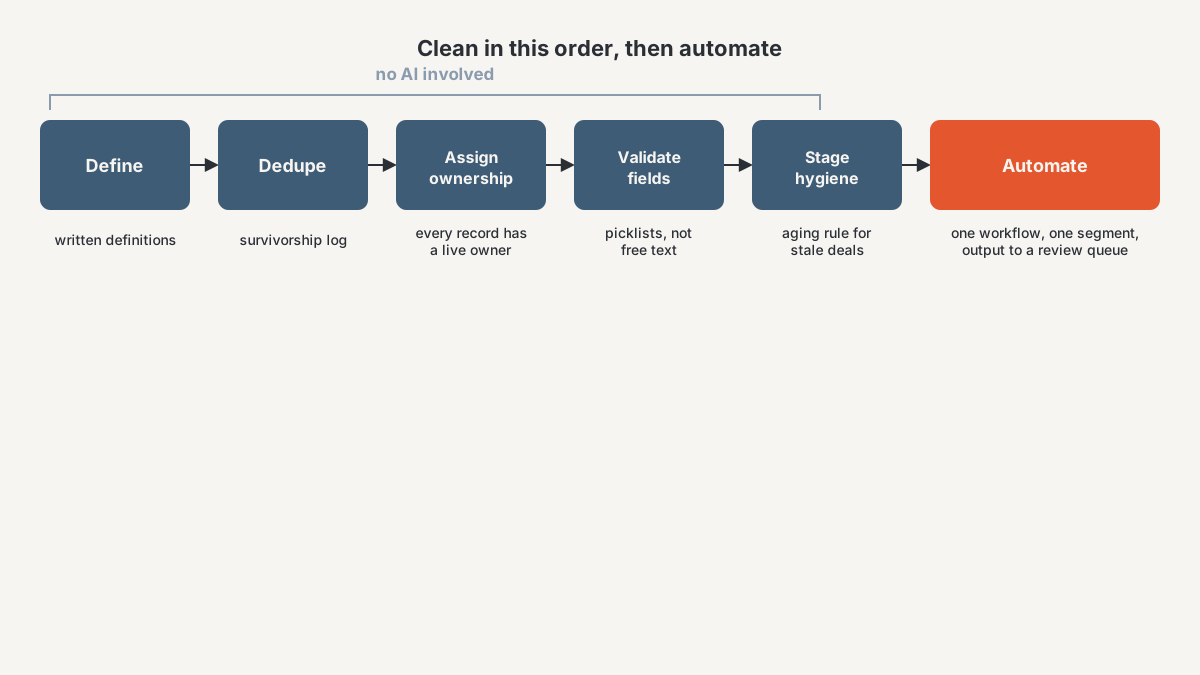
Order matters more than effort, because several of these steps invalidate each other if you run them backwards. Deduplicating before you've defined what a duplicate is means doing it twice. Assigning owners before deduplicating means assigning owners to records you're about to merge away. The sequence I run:
- Define. Write down what a lead is, what a qualified lead is, which stage means revenue, and what every field feeding an automated decision means. One page, in business language, agreed by whoever owns the client relationship. These are business decisions rather than configuration decisions, and skipping them is why two people run the same report and get different answers. Same exercise as an agency KPI dictionary.
- Dedupe. Normalize identity fields first (lowercase emails, strip whitespace, standardize phone to E.164), then match, then merge. Decide the survivorship rule before you start: which record wins, which fields carry over, what happens to conflicting attribution. Log every merge, because a client will eventually ask why a contact shows the source it does.
- Assign ownership. Every active record gets a live human owner, and records belonging to deactivated users get reassigned or archived. Add a rule that stops new records being created without one, otherwise you're back here next quarter.
- Validate required fields. For each field an automation reads, decide whether it's required, what values are legal, and what happens when it's empty. Convert free-text decision fields to picklists. Then fix the intake forms, because cleaning the database without fixing the source signs you up to do this again.
- Backfill and set a stage-hygiene rule. Sweep the stale records, then add an aging rule so it doesn't recur: anything untouched at a stage past a threshold gets flagged for a human decision.
- Then automate. One workflow, one segment, output going to a review queue rather than straight to a client or prospect.
The first five steps are unglamorous and none of them involve AI. That's rather the point. Most of what gets called "AI implementation failure" in an agency is those five skipped and then blamed on the model.
Which decisions belong to rules, and which to AI?
Once the data is clean, the next mistake is handing AI the parts of the workflow that don't need judgment.
Deterministic rules should own anything with a correct answer a person could verify. Routing by territory or account tier. Whether a lead meets a numeric threshold. Stage transitions triggered by an event. Suppression of anyone who unsubscribed. A rule engine handles those with an audit trail and a debugging path when they misfire. Give the same job to a model and you get output that varies between runs, can't be explained afterwards, and costs money per decision.
AI earns its place where the input is unstructured and the output tolerates being approximately right. Summarizing a call transcript. Drafting a first-pass reply a human sends. Extracting structured fields from a messy inbound email.
The dividing question I use: if this decision is wrong, does anyone find out? If the answer is no, it doesn't belong to AI running unsupervised. A wrong lead score nobody checks becomes a prioritization decision by default.
Two boundaries worth holding. Any number a client will check should be deterministic: revenue, lead counts, spend, cost per lead come from queries, not inference. And anything irreversible, sending, charging, deleting, changing a client-visible record, needs a rule or a human rather than a model acting alone.
What has to stay in human review?
"Human in the loop" collapses the moment volume gets high enough, unless you design the loop to be cheap.
Review everything at first. New workflow, first two weeks, every output goes to a queue and a person approves it. That's temporary, and it's how you find out your error rate before a client does.
Then narrow to permanent review on the expensive-to-be-wrong actions: first outbound contact with a new prospect, anything going to a client rather than staying internal, any AI-generated number entering a client report, and anything changing a record's stage or ownership.
Make review fast or people will rubber-stamp it. If approving twenty drafts takes forty minutes, they get approved unread by week three and you have the illusion of oversight, which is worse than none because you'll trust it. Batch the queue, show the source record beside the output, make rejection one click.
Sample what you don't review. Pull a weekly random sample of the unsupervised actions and check it properly. You're watching for movement in the error rate, and it will move, because CRM data degrades continuously while the automation's assumptions were set at launch.
Log everything somewhere you can query: which record, what input, what the automation did, when, and who approved it. Imagine a client asks why they received a particular email. Without a log the answer is "I don't know", and that costs more than the automation saved. I've covered the durable-history side in exporting GoHighLevel data to Supabase, and the controls layer in safe AI automation for agencies.
How do you know the CRM is clean enough?
There's no finish line. A CRM people use every day is always slightly dirty, so set thresholds and measure against them. Five checks I'd run before switching anything on, and monthly afterwards:
- Duplicate rate: contacts sharing a normalized email or phone. Track it over time. A rising line means intake is broken, not that the cleanup failed.
- Ownership coverage: active records with a live, non-deactivated owner. Should be at or near 100%. In the accounts I've opened, it rarely is on the first measurement.
- Required-field completeness, measured only on the fields your automations read. Completeness on fields nobody uses is a vanity metric.
- Stage age: how many opportunities have sat in the same stage past your threshold. Best proxy for whether the pipeline reflects reality.
- Field-value conformity: for each decision field, what proportion of values sit in the legal set. Below your threshold, that field can't drive an automated decision yet.
Put those on a dashboard and read them before you expand automation, not after something breaks. The longer walkthrough sits in the GoHighLevel reporting audit checklist.
Frequently asked questions
Does AI automation actually make bad CRM data worse?
Yes, in two ways. It acts on bad records without flagging them, so errors reach clients and prospects instead of stopping at a confused person. And it writes back: AI-generated summaries, scores, and stage updates land in the same database, and the next automation reads those as fact.
How long does a CRM cleanup take before we can automate?
That depends on record count and how many custom fields have accumulated conflicting definitions, not on the tooling. The definition step is usually the bottleneck, because it needs decisions from whoever owns the client relationship. Deduplication and normalization are faster than getting five people to agree on what "qualified" means.
Can't AI just clean the CRM for us?
For parts of it, yes: fuzzy duplicate matching, normalizing inconsistent formats, extracting structure from free text, suggesting merges. What it shouldn't do is set the rules. Which record survives a merge, what a stage means, which fields an automation requires: those are business decisions, and having a model infer them from existing data means inheriting whatever mess is already there.
Should we clean everything, or only what the automation touches?
Only what the automation touches, at first. Map the fields each workflow reads and writes, then clean those completely rather than cleaning everything partially. A field an automation depends on has to be right; a field nobody reads can wait. It also gives you a scope that finishes.
What's the first automation to switch on after a cleanup?
Something internal, reversible, and easy to audit. Meeting summaries attached to contact records, or classification of inbound enquiries, keep the output inside your own team where a mistake costs a correction rather than a client relationship. Save outbound messaging and anything writing to a client report until you've measured the error rate on the safe ones.
Get a CRM and reporting diagnostic
If you're planning AI automation on top of a CRM nobody has audited in two years, the automation isn't the first decision. Knowing what state the data is in is.
That's what the agency CRM and reporting diagnostic covers: a paid, bounded review of your CRM data quality, field definitions, and reporting logic that tells you which fields are safe to automate against, which need cleanup first, and in what order. You get the named problems and a prioritized fix list, whether or not you do the work with me.
Start a diagnostic, see how I work with performance-marketing agencies, or read what a data solutions and integration build looks like once the cleanup is done.
About the author. Ahmed Abdelkhalek is a Data Automation and Reporting Consultant and the founder of ChromiumData, a founder-led consultancy building reliable reporting and connected data workflows for performance-marketing agencies. He works with clients directly from diagnosis through delivery, usually on the parts nobody demos: CRM records that won't reconcile, fields that mean three different things, automations trusted a month too early. He holds the AWS Certified Solutions Architect (Associate) and Microsoft PL-300 certifications. More at chromiumdata.com/author/ahmed-abdelkhalek.